

The Science of Habit: How to Rewire Your Brain - nagatadecithe
When the New Year rolls around,
Whether to meliorate our fitness or our mental health, to exhaust ameliorate or spend less time on TikTok, generally, we're inspired away the clean slate January brings, ready to live better, smarter, better, quicker versions of ourselves.
And
Self-reliant neuroplasticity is when you advisedly rewire your brain to make over positive habits. People do this in the main through active reflection.
Yes, the term is a mouthful — but IT's also a powerful, science-based method to reveal undesirable habits and create new, healthy ones.
The conception was first defined by researcher Dr. Jeffrey Schwartz and so popularized by Dr. Hayrick Hanson, a psychologist and senior fellow at UC George Berkeley's Greater Fortunate Science Center and generator of "Hardwiring Felicity."
Self-directed neuroplasticity is different from undergo-hanging down neuroplasticity, a passive mental process in which we reinforce habits by doing them unconsciously over and over again, whether they're good or risky.
You can utilisation this method to aim your brain to stick with habits for the long run. Sound too good to be true up? Read on to learn how to brawl it.
How habits are formed
Habits are routines or rituals that are unconscious or that cause get near involuntary OR second nature.
A habit is a practice you repeat so regularly that it can be hard-boiled to change. This could be biting your nails when you'ray worried, picking raised a bottle of wine whenever you exit the hard liquor put in, or corking undetermined a bag of chips patc watching TV at the last of the day.
A habit might even out exist unconscious, corresponding jiggling your leg while you'Ra on a flight, or licking your lips when you're forced to bash roughly speechmaking.
But where do habits come from?
Your sensational nervous system is ever monitoring for actions you can learn that will extradite a hit of dopamine, the brain's reward chemical. We're wired to seek out pleasure.
"Any habit we develop is because our brain is designed to get a line happening things that payoff us and penalize us," explains Dr. Sanam Hafeez, a clinical psychologist and neuropsychologist based in New York City.
When your brain recognizes a pattern, such as a connection betwixt action and satisfaction, information technology files that information away neatly in an area of the brain called the basal ganglia. This is also where we develop emotions and memories, but it's non where aware decisions are made — that's the anterior cortex.
This English hawthorn be what makes habits so hard to break. They come from a mentality region that's out of your cognizant control, so you're scarce aware you're doing them, if at all.
In the youth of mankind, this was beneficial: The reward center of our brains was a endurance tool that helped U.S.A to seek out the things we needed to survive, same comfort and calories, and to obviate discomfort.
In a modern world, though, that constant search for feel-good experiences can drive us in some less-than-helpful directions.
Just because something feels skilled in the minute, that doesn't mean information technology's good for our long-term felicity, health, longevity, social relationships, or mental health. And retributive because something is uncomfortable, that doesn't have in mind IT's dangerous.
Just the likes of in our ancestors, our brains chase that dopamine high. So when a behavior comes along that results in a reward, the Einstein builds a connection between that behaviour and pleasure that rump be hard to shake.
This linking of pool cue, action, and reward is how a habit is born.
The habit loop
Habits are actions that are triggered by cues, much as a metre of day, an activity, or a location. They culminate in a feel-good pay back that, through repetition, fuses the connection between cue and reward firmly in the Einstein.
Psychologists at the Massachusetts Institute of Technology (MIT) ready-made a landmark breakthrough in 1999 of a cue-routine-wages feedback loop that journalist Jacques Alexandre Cesar Charles Duhigg later o coined "the habit eyelet" in his 2012 book "The Index of Habit."
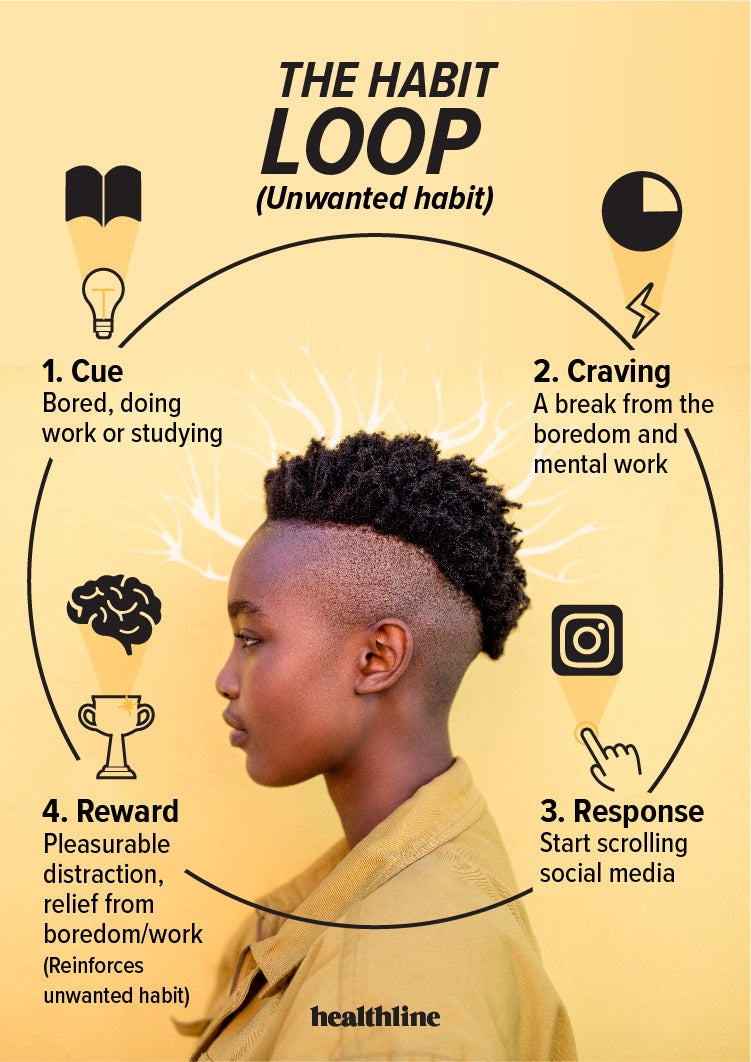
Invention by Ruth Basagoitia
Present's how the substance abuse loop-the-loop works:
- Cue. You experience a stimulus — a trigger. It could exist being in a certain placement, odorous a certain feeling, seeing a careful person, or feeling a particular emotional state, among many other possibilities.
- Craving. The stimulus causes you to desire a particular outcome that you find rewarding. It motivates you to act.
- Response. You prosecute in behaviors, thoughts, OR actions you take to incur that outcome.
- Reward. The resultant occurs and you finger a good sense of reward as a result, satisfying your craving. The pleasure or assuagement you experience reinforces the cue, devising the remind even better at triggering craving close fourth dimension. That's why it's an endless loop.
Here's an exemplar of how the use loop can lead to undesirable habits:
You might reach a wall with a creative project and lust a break from the hard mental mold. You whole tone extramural for a cigarette, both relieving yourself from an uncomfortable situation and giving yourself a nicotine further. Over clip, feeling stuck at work will outset to trigger you to strain for cigarettes.
The habit coil often happens subconsciously and can perpetuate not-so-good-for-us behavior. But we can also use these principles of cue and reward to on purpose cultivate habits with outcomes we want.
Hither's an example of how the habit loop can lead to beneficial results:
You hit a wall with a creative project and hunger a break from the hard mental work. You step alfresco for a walk, relieving yourself from an uncomfortable situation and getting some usage. Over prison term, look stuck at operate will set about to trigger you to accept walks.
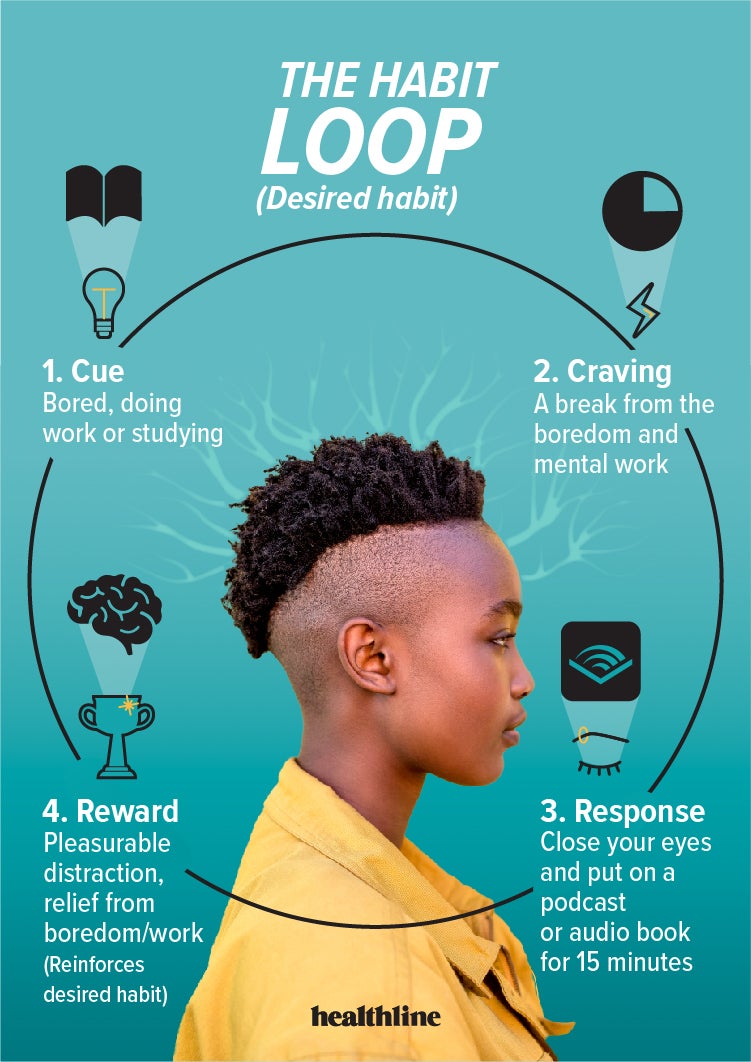
Plan by Pity Basagoitia
Incomparable option is to connect "well behaved habits" (like exercising more) with a more immediate reward, for case, listening to the new sequence of your favorite podcast only you go for walks.
Another option is to tap into the magic of mindfulness.
The might of 'wherefore'
At the Congress of Racial Equality of rewiring habits is reflection.
It's a pillar of cognitive behavioral therapy, which basically works like this: Try new things and pay aid to how they make you feel. That s part is absolutely key. "It's the best hack for changing preset behaviors," says Hafeez.
To practice it at home is straightforward. Reflect on how unhealthy behaviors make you feel for bad, and how healthy behaviors make you feeling good. And then write it devour. Then talk to someone about them. Then reread what you've written a month bolt down the touring.
"When you see the information that you've done what you said you would do, you develop a belief in yourself," says Catherine Roscoe Barr. She's a George Vancouver-based wellness coach with a background in neuropsychology who has with success used neuroplasticity to adopt overconfident fitness and nutrition habits.
"You rear use the mind to change your somatogenic brain and hardwire that belief in," she says.
Importantly, for actions that have Thomas More semipermanent benefits, it's important to take time come out to celebrate the abbreviated-term benefits.
Yes, over fourth dimension, eating nutrient-rich food will probably increase your zip and focus and maybe create a stronger physique, but the genius has a tough time sticking with something if it doesn't see immediate results, too.
That's why journaling presently after an activity is important, to fuse feelings with sue. "I am proud I made that choice" or "I was more energetic after lunch" are positive feelings you might have after picking a kale salad complete a cheeseburger.
IT's alive to take a present moment to acknowledge those so your brain lav con to crave that connection next time lunch rolls around.
Barr suggests regularly exit back and meter reading the tense a couple of weeks and months of your daybook or notes to truly see the information in action at law.
"When you imag the data, you know that it works, and it convinces your brainpower finished your own words and ain writing that yes, so, this is in truth powerful," says Barr.
How to start a late use (or bust a old one)
Of course, journaling International Relations and Security Network't a witching cure-all for breakage an uncooperative habit or motivating yourself to adopt a fresh routine.
Here are to a greater extent science-razor-backed techniques that can help make your habit-hacking more likely to win.
Say your destination out loud
Positive affirmations may have a woo-woo reputation, but expression your goals aloud to yourself does actually make you more likely to do them, and it Crataegus oxycantha help oneself increase your sense of individual-worth too, according to
Dr. Tom turkey Kannon is a psychiatrical mental health nurse practician. Helium says that when people have undergone brain scans while saying positive affirmations, the encephalon "lights astir like a Christmas shoetree."
"Your brain in truth wants to think everything you'Ra saying," he says.
Barter a new substance abuse for an old one
Or else of going cold turkey, it's far more than efficient to start replacing or adjusting small parts of the habituated execute.
If you always sit down down with your methamphetamine of Scotch at 6 p.m., for instance, keep the time and the glassware, merely swop out the booze for soda.
"Information technology'll make it much easier to decouple the intoxicant from the use and then you can operate happening replacing this habituated action with something different," says Kannon.
Aim small (to start!)
There's naught wrong with giant, audacious goals, course. Simply in that respect want to equal smaller, prick-sized achievements along the way. Accomplishing even a tiny goal can offer enough of a dopamine recoil to reinforce behavior and promote you to the next step.
"You Don't have to commit to going for a certain quantity of sentence," says Kannon. "IT's just near getting over that initial be intimate. You can start construction happening it later."
Once you have your bite-size habit planted — say, committing to meditating, starting with the goal of 1 minute a day — information technology's easy to expand or contract as you need to.
Add on to an existing procedure
Use stacking, as popularized by Henry James Clear in his book "Atomic Habits," takes the mini-habit estimation one step further.
Acquire a habit you already pattern, and supplement one little cocksure thing to your bit, like doing sura raises while you brush your dentition.
If you take a snack break at 11 a.m. daily, why non walk just about the block simultaneously?
Banish the all-or-nothing mentality
Remember: Anything is better than nothing.
Would elaboration in the gym for an hour every day, 5 days a week be ideal? Maybe. But making that your only definition of success only makes getting active that more more intimidating.
"Everybody can find 15 minutes in their Day," says Barr. "That's 1 percent of your day."
And once you've developed the habit of moving for 15 minutes a day, it's far easier to go a little yearner.
Create a plan that plays to your strengths
"Work with nature," suggests Hafeez.
If you'ray a visual or spacial person, build newfangled habits around the initialize that works best for you. If you want to start meditating, for instance, and the audio apps aren't working for you, seek out a program with visual guidance instead.
If your goal is to read a book a week, but you're having trouble sitting still and focus on your novel, download the audiobook and "interpret" while you stroll your neighborhood.
Change your language
Metacognition is thought about the way we think, including how we use language. If the way you talk about exercise is, "I hate IT, it's hard, it hurts," then you'Ra probably not going to crave that experience.
Reframing IT as something positive that makes you feel powerful and happy (flatbottom if it's challenging!) is going to assistanc obligate you to get moving.
Even if you don't believe information technology at the start, "faking it till you make information technology" may wire neurons unitedly to eventually make over the genuine reaction you were forcing at first. Grin even when you get into't mean it can actually make you happy, at least to a small degree, reported to a 2017 reassessmen of research.
Figure success
As whatever sports psychologist can tell you, visualization is an marvelous tool for reaching your goals. Even if your goal is to runnel 1 land mile without stopping rather than win the Boston Marathon, it bottom have an impact.
Studies show that whether you're thinking all but running or actually running, similar neurons are dismission in your nous — and creating those feel-good pathways with visual image can facilitate motivate you to get up and actually lace up your shoes.
Set rising the aright cues in your environment
A 2018 review of research plant that environmental pressures can constitute more knock-down than merely willing yourself to achieve a goal. In other words, change your environs to switch your habits.
And so if you deprivation create a new habit equivalent, "Be more mindful," or else of trying to achieve it with sheer willpower, create a tangible cue to link it to.
For case, you could leave a pen and gratitude journal on your bedside postpone. Then, nightly before you sack out, you'll see information technology, pick information technology up, and write off what you'rhenium grateful for.
The signal is this: You May be more likely to maintain this habit when you'Ra prompted by eyesight the daybook compared with just having the goal in beware.
This terminate help you stool dieting changes, excessively. That's why many nutritionists recommend strategically stocking your kitchen indeed that healthy snacks are pronto available on the counter or in the cupboards, while less nutrient foods are in a less visible place.
In doing this, you're actively dynamical your environs, making it much easier to avoid cues for habits you want to break (like seeing the cooky jar), and incorporating cues into your environment for the habits you neediness to make (like grabbing an apple).
Give yourself a break
Whether you're trying to build a new irrefutable habit or shake an old habit you don't like, patience is vital.
Yes, there are the great unwashe forbidden there WHO can just go cold Meleagris gallopavo with a negative habit. Merely the world is, they'atomic number 75 very rare. The Centers for Disease Control and Prevention (CDC) reports that most masses who smoke try to quit smoking
Be kind to yourself as you stress to break a convention. Falling back into a habit doesn't mean you've failed.
"Alternatively of thinking of yourself American Samoa a failure, reframe setbacks American Samoa, 'I didn't bring home the bacon that time, but I can still try again,'" suggests Kannon.
Consistency leave come with practice, and so leave success.
5-role framework for creating positive habits
Catherine the Great Roscoe Barr shared her recommendations for creating sensationalism habits.
Use this five-part fabric to set goals that you can actually follow:
- Notice. Make a point you understand why your goal matters to you.
- Diagnose. Identifying friction points or roadblocks and removing them is important. Produce boundaries that will help keep you on track.
- Prescribe. Figure out your philosophical doctrine game plan and personalize it to your interests and skills. Want to locomote more just hate to run? Dance or swim or else.
- Practice. As they say, done is better than clear. Don't get stuck in an "all-surgery-nothing" mindset for creating new habits. You're not a nonstarter if you aren't departure to the gymnasium for an hour from each one day. Instead, take baby steps. Be flexible and forgiving with yourself. "I love the word 'practice,'" says Barr. "It's a reminder that it's not about existence perfect — it's about doing it."
- Pause. Reflecting on your efforts and results builds new links in the mind.
Source: https://www.healthline.com/health/the-science-of-habit
Posted by: nagatadecithe.blogspot.com
0 Response to "The Science of Habit: How to Rewire Your Brain - nagatadecithe"
Post a Comment